
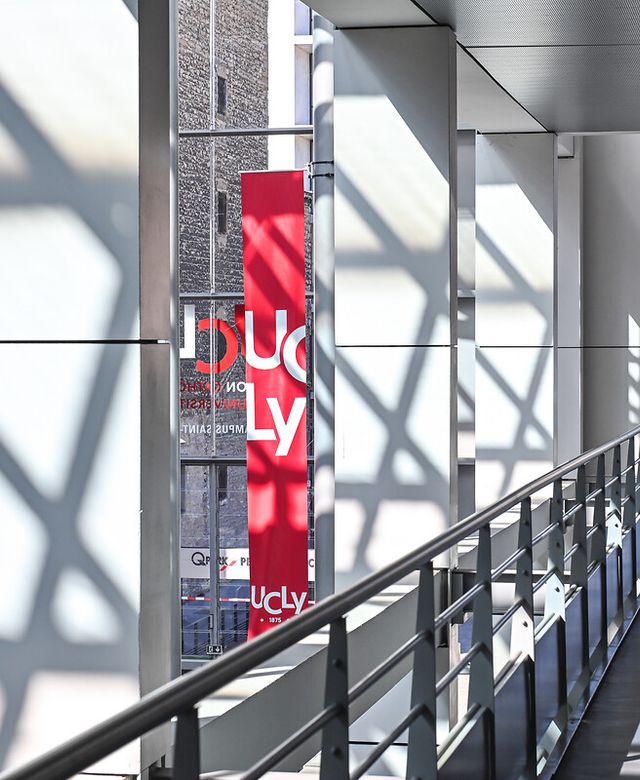
A positive start to the 2026 academic year, driven by regional development
The 2026 academic year has got off to a positive start at UCLy, with a slight increase in student numbers (+2%) and several years of financial stability. With its Lyon campuses now well established, the university continues to grow through its Alpes Europe campus in Annecy and its expansion into Marseille, with Aix-en-Provence soon to follow.
Despite a significant increase in applications through Parcoursup, France's national higher education admissions platform, student numbers have grown moderately. “We have reached the enrolment limits for our degree programmes delivered under agreements with the French State,” explains Grégory Woimbée, Rector of UCLy. “Our challenge now is to develop new programmes that meet both students' expectations and the needs of local communities.”
This approach is reflected in the creation of the Schuman School, dedicated to European and international political studies, and the Institut Richelieu, which brings together history and geopolitics.

"One Education": an educational ambition at the heart of UCLy's 2032 strategy
These solid foundations allow UCLy to look to the future with confidence and pursue ambitious projects. Grégory Woimbée recently presented the university's 2032 strategy to the press, with "One Education" as its guiding educational vision.
The concept brings together three fundamental dimensions of education: educating the whole person, recognising each individual's uniqueness, and fostering a sense of collective responsibility.
The first dimension is rooted in a holistic understanding of education
“In the Catholic tradition, we refer to this as integral education,” explains the Rector.
Inspired by the Christian humanism that lies at the heart of UCLy's identity, this approach responds to the needs of students in an increasingly complex and fragmented world. Education goes beyond academic and professional training by embracing every dimension of the human person.
“Our responsibility cannot be limited to imparting knowledge and preparing students for a profession,” continues Grégory Woimbée. “We must teach students to connect different areas of knowledge, exercise discernment and develop their talents so that they can act in the service of others and society.”
The second dimension focuses on the uniqueness of each individual
“We must enable everyone to develop their own individuality,” emphasises Grégory Woimbée. “Standardisation and uniformity are among the pitfalls of higher education and, more broadly, of society today.”
A key priority is therefore to maintain the personalised academic support that is one of UCLy's strengths, as reflected in its outstanding undergraduate completion rates: 85% of students complete their bachelor's degree within three years.
The third dimension of "One Education" is about bringing people together.
To illustrate this collective dimension, the Rector referred to social movements involving secondary school and university students calling for a renewed approach to education and greater intergenerational solidarity.
“We need to move beyond individualism,” says Grégory Woimbée. “We must restore an approach to education and science that strengthens our sense of community, moving away from exploitative practices, selection and competition.”
In the coming years, student representation and participation will therefore be central to the "One Education" strategy.
“We must empower students to become active participants in their own education, rather than simply its beneficiaries,” explains Grégory Woimbée. “They must be involved in shaping the future of the university alongside academic staff, entrepreneurs and representatives of civil society.”
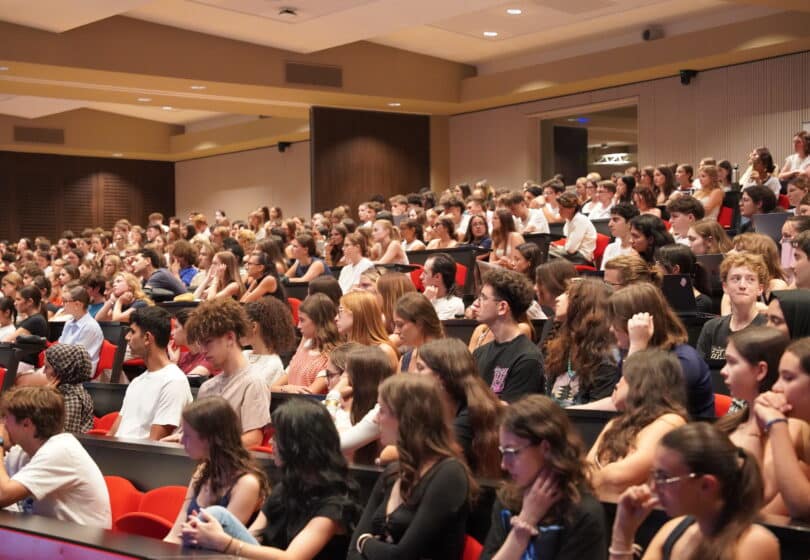
Campuses supporting education, research and local communities
UCLy's 2032 strategy is already taking shape through several campus development projects.
On the Saint-Paul campus, construction of the future Biotech Hub is progressing as planned, with its opening scheduled for September 2027. Covering 380 square metres and equipped with state-of-the-art technology, this pre-industrial scale-up laboratory will meet Biosafety Level 2 containment standards.
The new facility is designed to strengthen practical training for ESTBB students and provide an environment for innovation, bringing together fundamental research, start-up research and development activities, and doctoral students in molecular biology.
“These new laboratories will raise the profile of science at UCLy,” explains Grégory Woimbée. “This is an important step for a university that embraces science and technology in an ethical way and in the service of society.”
The university is also pursuing its commitment to the social and ecological transition through an urban farming project currently under consideration on one of the Saint-Paul campus terraces. Designed as a space for learning, experimentation and raising awareness of social and ecological challenges, the urban farm could also help supply UCLy's student solidarity grocery store and local charities in Lyon.
In Annecy, UCLy is working on plans to develop a student residence close to its Alpes Europe campus.
“We have found that many students live a considerable distance from the campus, sometimes more than an hour's drive away,” explains Grégory Woimbée. “The aim is therefore to address housing and mobility challenges.”
The project is currently being explored in collaboration with local authorities and business partners.
These three campus development projects reflect a shared ambition: to create spaces where education, research, experimentation and engagement come together in the service of society and local communities.
More broadly, UCLy's 2032 strategy is driven by a commitment to breaking down barriers between disciplines, rethinking academic programmes and strengthening ties between the university and society.
Through "One Education", UCLy reaffirms its commitment to an education that recognises each student's individuality, goes beyond the acquisition of knowledge and professional skills, and empowers every student to understand a changing world and play an active role in shaping it.