
A strategic partnership strengthening the ties between UCLy and Saint Joseph Saint Luc Hospital
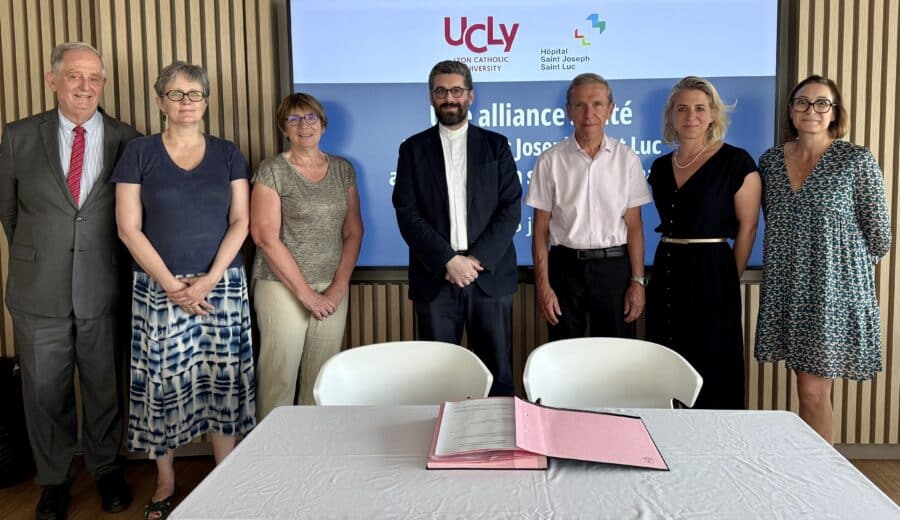
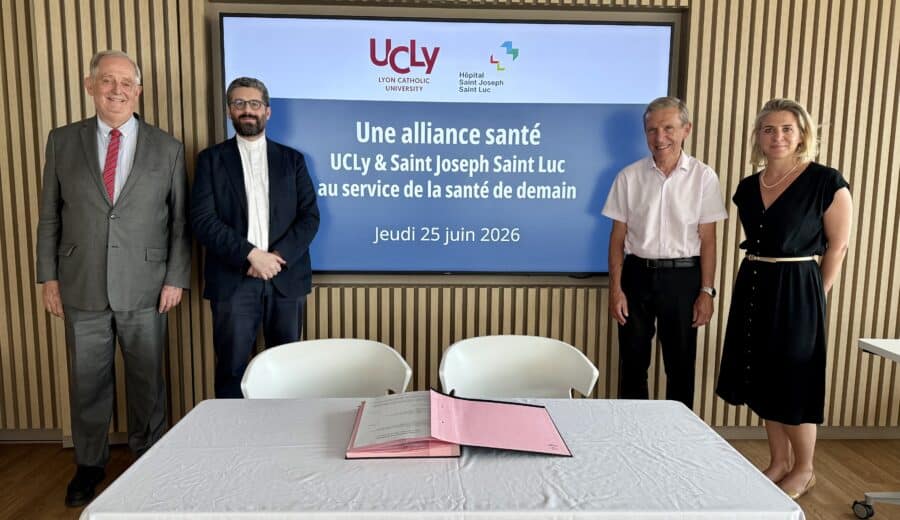
On Wednesday 25 June 2026, UCLy and Saint Joseph Saint Luc Hospital (SJSL) officially formalised a strategic partnership dedicated to healthcare, education, research and innovation.
More than a cooperation agreement, this partnership marks a new chapter in a relationship that has linked UCLy and Saint Joseph Saint Luc Hospital for more than 130 years. It reflects a shared ambition: to strengthen the longstanding ties between UCLy and Saint Joseph Saint Luc Hospital so that, together, they can better address today's major healthcare challenges.
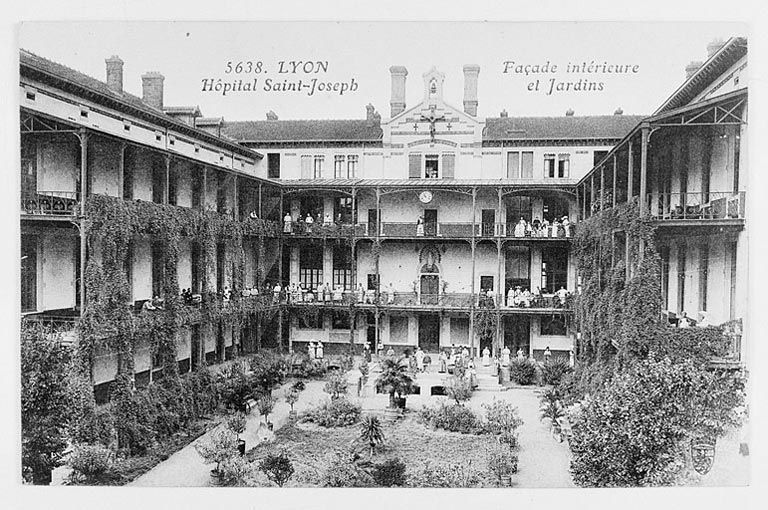
The close relationship between UCLy and Saint Joseph Saint Luc Hospital extends far beyond their shared spiritual heritage. The current Saint Joseph Saint Luc Association was created through the merger of Saint Luc Hospital and Saint Joseph Hospital, the latter having been closely linked to UCLy since the University's foundation in 1888.
This historical connection gives UCLy the status of founding member of the association that now governs the hospital. Under the association's statutes, the President of AFPICL (the Association of the Founders and Protectors of UCLy) serves as First Vice-President of the Saint Joseph Saint Luc Association. In return, the President of the hospital also sits on UCLy's Board of Directors.
A shared history that continues today
Some partnerships begin with a first meeting. Others are built on a long-standing relationship. The ties between UCLy and Saint Joseph Saint Luc Hospital date back to the creation of Saint Joseph Hospital in 1888, of which the University was one of the founding members. Since then, these links have continued to grow stronger.
Today, this collaboration is reflected in joint academic initiatives, cross-institutional teaching, shared research projects and reciprocal representation within each institution's governing bodies.
Rather than creating a new partnership in the traditional sense, this strategic alliance provides an overarching framework, a shared roadmap and a long-term vision for a collaboration that has existed for generations.
A shared commitment to the public good
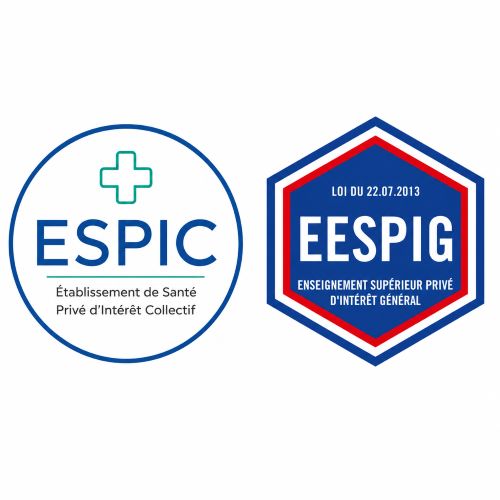
UCLy and Saint Joseph Saint Luc share much more than a common history. Both are private, not-for-profit institutions entrusted with a mission that serves the public interest. UCLy is a Private Higher Education Institution of Public Interest (EESPIG), while Saint Joseph Saint Luc is a Private Non-Profit Healthcare Institution Serving the Public Interest (ESPIC).
Addressing tomorrow's healthcare challenges together
An ageing population, changing healthcare professions, mental health, artificial intelligence, therapeutic innovation and rising patient expectations... As healthcare continues to evolve, universities, hospitals and socio-economic partners are increasingly called upon to work together.
For UCLy, this partnership is fully aligned with the UCLy 2031 Strategy, which identifies global health as one of the University's major strategic priorities.
The ambition is to develop more integrated forms of cooperation that bring together science, ethics, innovation, the humanities, applied research and support for the most vulnerable.
As UCLy's Rector, Professor Grégory Woimbée, explains:
"Today's major healthcare challenges require new forms of cooperation. This partnership reflects our determination to bring the University, the healthcare sector, research and innovation even closer together, helping to promote a more human-centred, interdisciplinary and responsible approach to healthcare."
A partnership designed to grow
Signed for an initial period of five years, the framework agreement sets a shared direction through to 2031. It will gradually give rise to initiatives across several strategic areas.

Educating differently
Develop new undergraduate and continuing education programmes, strengthen links between university teaching and hospital practice, and support the changing needs of healthcare professions.
Innovating together
Launch new collaborative research projects, encourage experimentation and jointly respond to national and international calls for projects.
Advancing healthcare simulation
Explore the development of new immersive learning environments, innovative training programmes and, ultimately, a regional centre of excellence for healthcare simulation.
Bringing science, healthcare and society into dialogue
Organise conferences, symposiums and interdisciplinary initiatives addressing today's major issues, including ethics, artificial intelligence, vulnerability, global health and the changing nature of healthcare professions.
Strengthening the region's influence
Mobilise academic, institutional and economic networks to enhance the attractiveness of the Lyon metropolitan area as a leading centre for healthcare.
A partnership already under way
While this alliance marks the beginning of a new chapter, it already builds on several concrete achievements. These include the EPI-PSY Chair, led by ESTBB, UCLy’s engineering school specialising in biotechnology, in partnership with Saint Joseph Saint Luc Hospital.
Dedicated to exploring the links between epilepsy and associated psychiatric disorders, the Chair perfectly embodies the philosophy of the Health Alliance: bringing disciplines together, bridging the gap between research and clinical practice, and developing more comprehensive approaches for the benefit of patients.
Other projects in the fields of continuing education, healthcare simulation, ethics and global health will gradually further enrich this cooperation.
A forward-looking ambition
Through this alliance, UCLy and Saint Joseph Saint Luc Hospital have chosen to establish their cooperation on a long-term basis. Beyond the projects it will generate, the alliance reflects a shared conviction: the major challenges facing healthcare can only be addressed by bringing together knowledge, disciplines and experience.
Educating, caring, conducting research and innovating… but above all, working together to build a more human-centred, open and responsible vision of healthcare. This is the ambition behind the alliance.