
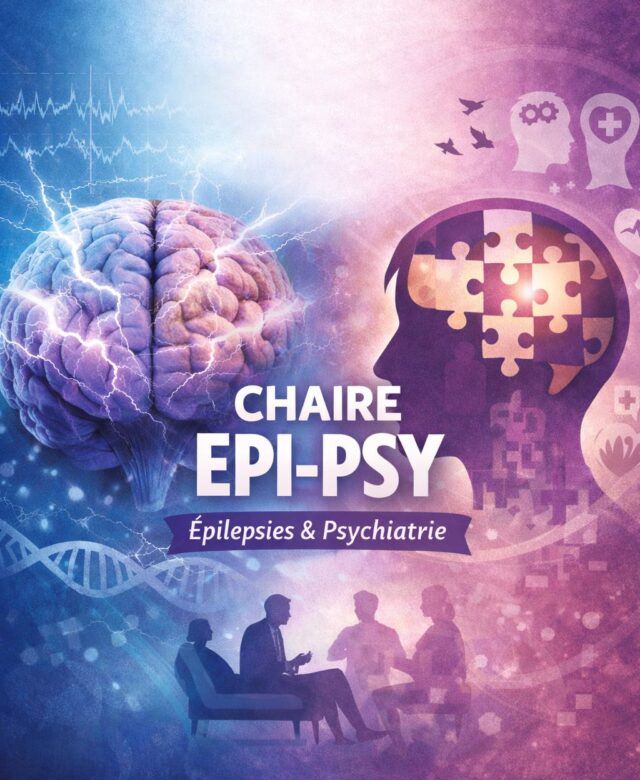
A teaching Chair supported by ESTBB, UCLy's biotechnology engineering school
Epilepsy affects millions of people worldwide, many of whom also experience psychiatric symptoms that can significantly impact their quality of life.Against this backdrop, UCLy, alongside with the Saint Joseph Saint Luc Hospital (Lyon) and the La Teppe Institute (Tain-l'Hermitage), is launching the EPI-PSY Chair (EPIlepsy and PSYchiatry).
This new teaching Chair is supported by ESTBB, UCLy’s biotechnology engineering school.
The EPI-PSY Chair aims to strengthen the training of healthcare professionals on the links between epilepsy and associated psychiatric conditions—an area that remains insufficiently understood despite representing a major public and mental health challenge.
Addressing an under-recognized mental health issue
For people living with epilepsy, the unpredictability of seizures can lead to chronic anxiety, loss of self-confidence, social isolation and, in some cases, severe depression, sometimes associated with an increased risk of suicide.
In addition, psychogenic non-epileptic seizures, which may closely resemble epileptic seizures, further complicate diagnosis and care, increasing the overall burden of the disease for patients.
These psychiatric conditions are often under-identified and under-diagnosed, as their symptoms may overlap with or be mistaken for neurological manifestations of epilepsy itself. This diagnostic complexity now represents a major clinical challenge at the crossroads of neurology and psychiatry.
A Chair built with and for healthcare professionals
The EPI-PSY Chair is built on a solid academic foundation and on institutions recognised for their expertise in the treatment of epilepsy and associated psychiatric disorders. Practitioners from around a dozen national centers of excellence in epileptology - foremost among them the Epileptology Department of the Hospices Civils de Lyon (HCL) -, take part in the Chair's steering and scientific committees.
The initiative forms part of a broader effort to structure knowledge and training for healthcare professionals who regularly face these complex clinical situations in their practice.
The Chair is co-chaired by Dr Adrien Didelot, neurologist and epileptology specialist at Saint Joseph Saint Luc Hospital (Lyon), and Professor Coraline Hingray, psychiatrist at Nancy University Hospital. Academic coordination is ensured by two ESTBB faculty members, particularly for the development of teaching activities and the organisation of scientific events, including an inaugural symposium on 15 and 16 January.
As Dr. Adrien DIDELOT points out: "This is a unique initiative that enables professionals from diverse backgrounds—academics, physicians and healthcare practitioners—to meet and share knowledge on a subject that is both common and still widely misunderstood in people with epilepsy. The Chair was designed around a comprehensive approach, focusing on the patient in all their dimensions, not solely on the disease."
Better training to improve detection and patient care
The primary objective of the EPI-PSY Chair is to develop structured teaching on epilepsy and its psychiatric comorbidities in order to:
- train and inform healthcare professionals who work with patients with epilepsy,
- improve understanding of the psychological mechanisms associated with the disease,
- promote earlier detection of depressive and anxiety disorders,
- contribute to comprehensive and coordinated patient care that fully integrates mental health considerations.
A national and multidisciplinary scientific organization
The Chair is supported by both a steering committee and a scientific committee bringing together neurologists and psychiatrists from around a dozen French university hospitals. This structure ensures a national, multidisciplinary approach and a high level of scientific and clinical expertise.
Towards the creation of a dedicated university degree to structure teaching
Following the inaugural symposium, the Chair will organise three workshops per year, combining lectures, interactive workshops and expert discussions.
These sessions will serve both as platforms for knowledge exchange and as testing grounds for innovative teaching formats, ultimately contributing to discussions around the creation of a future university diploma dedicated to epilepsy and its psychiatric comorbidities.