
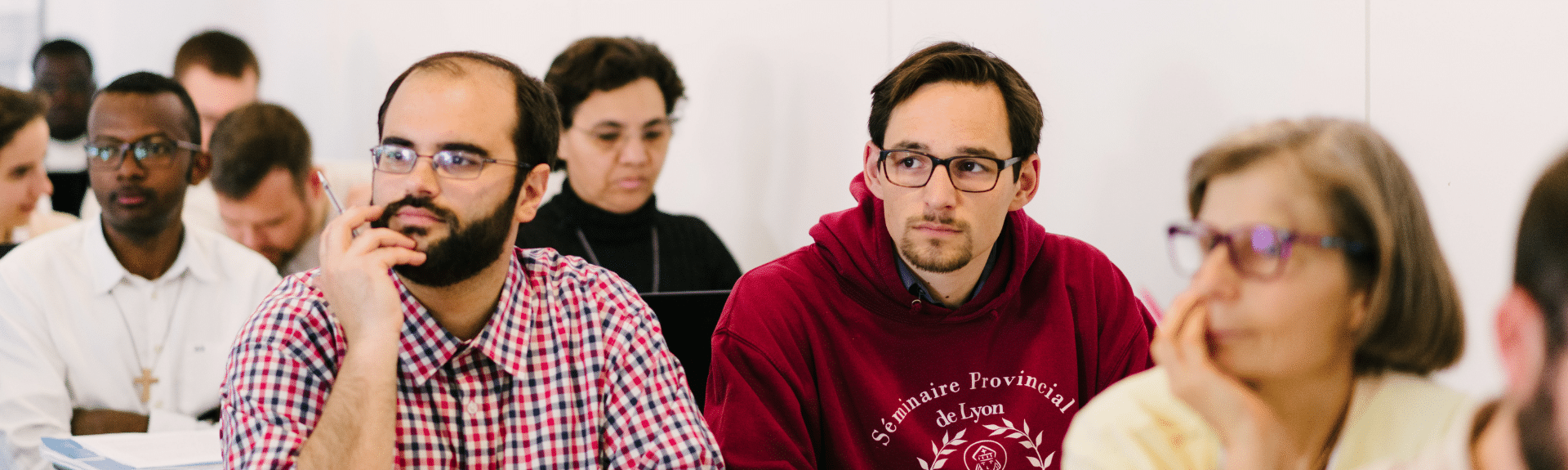
Master’s and Doctoral programmes in Social Sciences: two degrees dedicated to human and social vulnerabilities
“Conceptual frameworks are meant to foster contact with the reality we seek to explain, not to distance us from it.”
Pope Leo XIV, Apostolic Exhortation Dilexi te (2025), quoting Pope Francis, Apostolic Exhortation Evangelii Gaudium (2013), §194.
Established at UCLy in September 2025, the Department of Anthropology and Sociology welcomed its first students in the 2026 academic year.
It offers two European degrees: a Master’s Degree in Social Sciences (Canonical Licence) and a Doctorate in Social Sciences (ethnology, anthropology, sociology, history and education sciences), both focused on human and social vulnerabilities.
As a pontifical institution, the Department of Anthropology and Sociology awards Holy See degrees (canonical degrees) recognised at both European level (Bologna Process, 1999) and French level (France–Holy See agreements, 2008 [1]).
Students also have the opportunity to pursue a dual degree programme with the University of Perugia (Italy).
Research within the Department of Anthropology and Sociology is connected to the Confluence Research Unit: Sciences and Humanities (EA1598) at UCLy, particularly through its Research Groups (RG): Theology, philosophy and religious studies in contemporary contexts (RG 1); Culture(s), language and imaginaries (RG 3); Person, guidance and education (RG 4); Ecology, epistemology and ethics (RG 5).
The Department trains students in issues related to cultures and societies through the methods of social sciences. It draws on ethnology, sociology, social and cultural anthropology, history, education sciences, and psychology. It particularly welcomes students with backgrounds in humanities, social sciences, and religious studies. In order to better understand contemporary social transformations and provide students with tools for civic engagement, the Department has chosen to focus on the study of vulnerabilities. In doing so, it builds on the work of the University Chair on Vulnerabilities (2019–2024), extending its research and educational mission.
Placing vulnerability at the heart of research and teaching in Social Sciences means considering it as a complex concept (“everything is interconnected [2]”) and as something intrinsic to life itself (“we are all vulnerable”), from a Christian and, more broadly, humanistic perspective. It also reflects a commitment to supporting individuals and communities experiencing vulnerability, exclusion or marginalisation.
Teaching staff
Permanent lecturers of the Department of Anthropology and Sociology
Valérie AUBOURG: Professor of Anthropology (HDR and nihil obstat) and Dean of the Faculty
Antoinette CASTELNUOVO: Professor of History (nihil obstat) and Vice-Dean of the Faculty
Fabio ARMAND: Associate Professor in Anthropology and Language Sciences
Olivia LEGRIP: Associate Professor in Anthropology
Christine PLASSE-BOUTEYRE: Associate Professor in Sociology
[1] Decree No. 2009-427 of April 16, 2009 publishes the December 2008 agreement between the French Republic and the Holy See concerning the recognition by the French State of degrees and diplomas awarded by ecclesiastical faculties duly accredited by the Holy See. It follows the structure of similar agreements established within the framework of the 1999 Bologna Process.
[2] Pope Francis, Encyclical Letter Laudato si’, LS 91, 2015.
Our programmes

Le Master en sciences sociales de l’UCLy donne des clefs pour s’engager dans la société, en privilégiant l’étude des vulnérabilités.

Au sein de l’Unité de Recherche de l’UCLy, ce doctorat canonique en Sciences Sociales prépare à une activité d’enseignement et de recherche.